VRM To De Leon Character Pipeline
Hello there!
Today, I’ll be sharing how I built a streamlined pipeline that converts VRM (Virtual Reality Model) characters into fully functional, game-ready characters compatible with my De Leon format — all in just a few clicks.
The Problem: Manual Character Setup
In Unity — or any game engine — preparing a new character for gameplay often involves a repetitive and error-prone process of manually attaching custom components. For my project, that meant:
- Custom ragdoll setup
- Head look system
- Root motion handling
- Physics and collision setup
Doing this by hand for every character was not only tedious, but it also increased the risk of inconsistencies and mistakes.
My Solution: An Automated VRM-to-DeLeon Pipeline
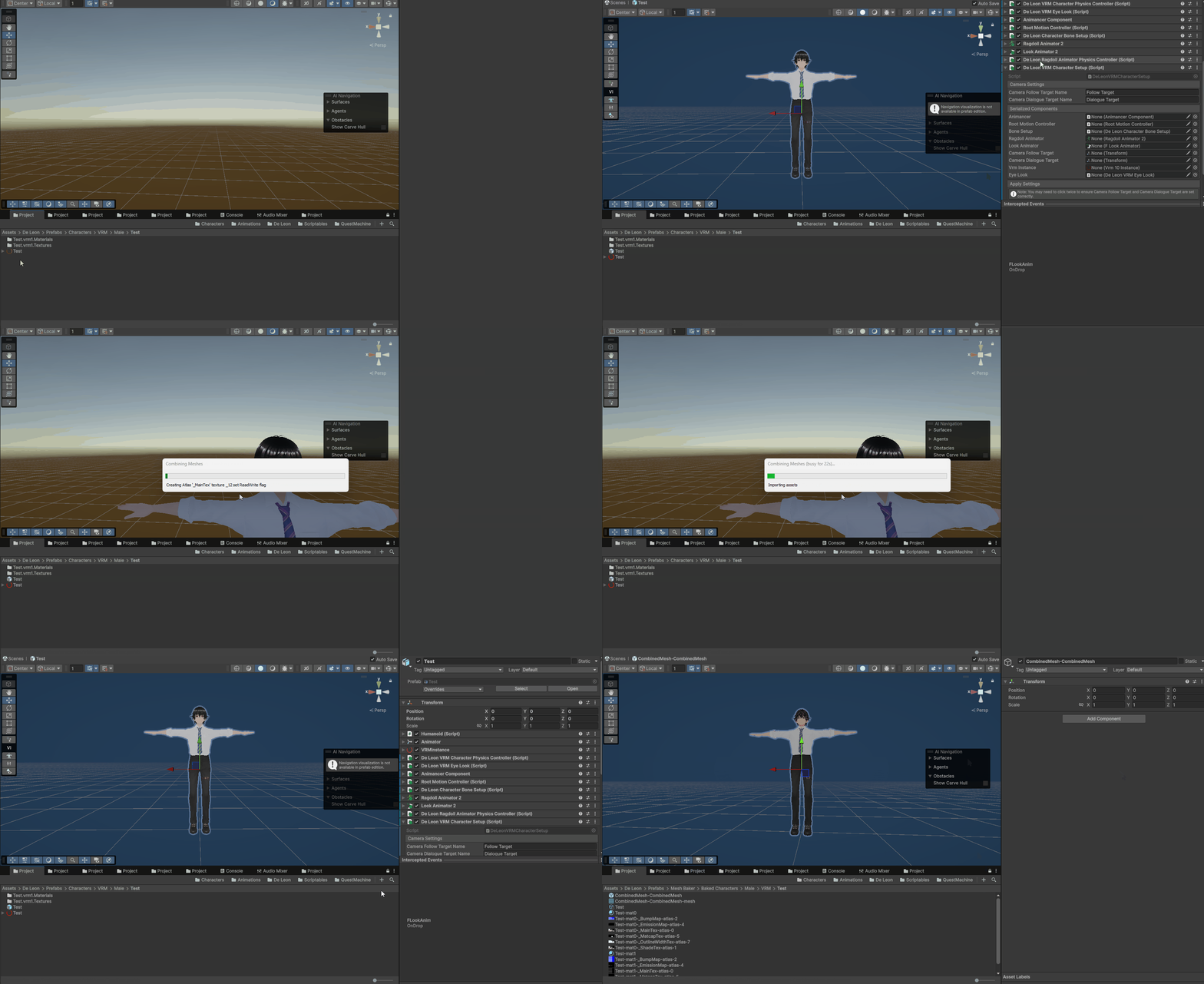
To solve this, I developed a custom Unity Editor script that automates the entire process. The pipeline:
- Injects all required custom components automatically
- Bakes meshes using Mesh Baker Pro, reducing draw calls via 4096×2048 texture atlas generation
- Combines meshes while retaining full blendshape support for facial animations
- Swaps the default VRM shaders with RealToon for stylistic consistency
All without touching the original VRM prefab — preserving a clean, reusable source.
The Results: Faster, Cleaner, Safer
This pipeline dramatically cuts down setup time, eliminates human error, and ensures that every character is game-ready in under two minutes. No more:
- Manually dragging in components
- Fiddling with mesh baking setup
- Swapping materials one by one
Just import, run the tool, and you’re done.
Here’s a quick gif showing the pipeline in action (click to play):
Final Thoughts
This system took multiple weekends of iteration, profiling, and polish — but the payoff is massive. What used to take 10–15 minutes per character (and left room for error) is now a streamlined, one-click process that’s fast, consistent, and scalable.
It’s built to support a growing cast of swappable characters with full mesh baking, animation support, and performance-conscious shader conversions. And because it’s fully modular, I can reuse it across future projects with minimal overhead.
Next steps? I’ll be expanding the pipeline to support outfit variants, voice and animation overrides, and runtime integration with my world population system.
Whether for solo development or studio work, systems like this free up time for content creation — and that’s where the magic really happens.